
If you’re dreaming about working in the heart of Europe—surrounded by rich culture, friendly communities, and some of the fastest-growing job markets—then the Poland Work Permit Visa might be your gateway.
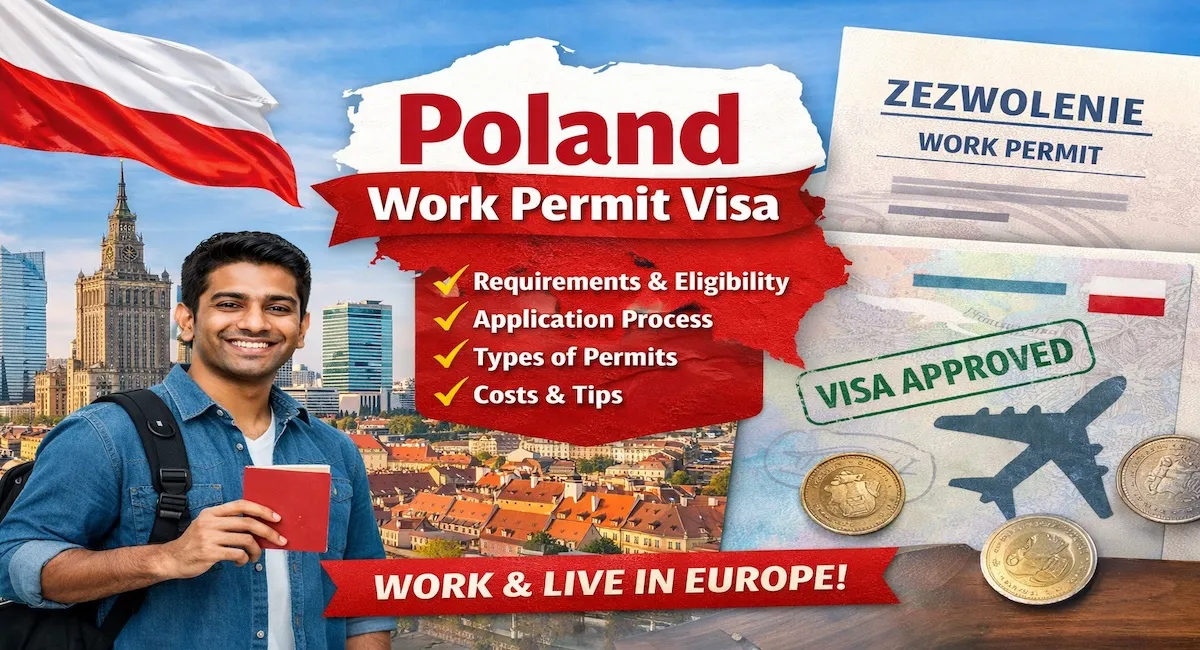
From bustling business hubs like Warsaw to picturesque towns steeped in tradition, Poland has quietly become one of Europe’s top destinations for foreign professionals, students, and skilled workers.
This guide breaks down everything you need to know: permit types, eligibility, costs, employer responsibilities, processing times, and insider tips—written in a simple, enjoyable, and engaging style.
⭐ Why Poland? A Short Story
Imagine this:
A young software developer from India—let’s call him Arjun—lands his first job in a European tech firm. He chooses Poland because it offers three things he values most: affordability, career growth, and a welcoming environment.
Within a year, he finds himself leading a small engineering team in Kraków, learning Polish phrases, and exploring medieval castles on weekends.
Today, Arjun recommends Poland to anyone who dreams of beginning a global career without the overwhelming cost and chaos of larger Western nations.
His story mirrors thousands of others.
Poland’s job market has become a magnet for:
-
IT and software developers
-
Warehouse and logistics workers
-
Healthcare professionals
-
Hospitality staff
-
Engineers and construction workers
-
Students looking for post-study work
And it’s not just anecdotal. Over 500,000+ work permits are issued annually, making Poland one of the top work destinations in Europe.
Let’s dive into everything you need to know.
🛂 What Is a Poland Work Permit Visa?
A Poland Work Permit Visa allows non-EU citizens to legally work, live, and earn in the country for a specific employer. Because European Union citizens can work freely in Poland, this visa is particularly important for workers from Asia, Africa, and the Middle East.
The work permit is typically issued based on:
-
A job offer
-
Employer’s application
-
Verification that no local worker could fill the role (in some cases)
🔍 Different Types of Poland Work Permits
Poland offers five main types of work permits. Choosing the correct one is crucial.
1. Type A – The Most Common Work Permit
For foreigners who work under a contract with a Polish employer.
Examples:
-
IT specialists
-
Restaurant workers
-
Hospitality staff
-
Construction laborers
-
Office staff
Validity: Usually up to 3 years, renewable.
2. Type B – Management / Board Members
For foreigners serving as:
-
Board members
-
Managing directors
-
CEOs
in a Polish company.
Validity: Up to 5 years.
3. Type C – Internal Transfer
For employees transferred from a foreign company branch to a Polish branch.
Example:
A marketing manager from a UK company gets transferred to the Polish office for 2 years.
4. Type D – Service Providers
For foreigners working temporarily in Poland for a foreign employer.
Example:
A technician repairing equipment for a foreign client in Poland.
5. Type E – Other Cases
A rare category used when the work doesn’t fit A–D.
🧾 Who Needs a Work Permit?
You need a work permit if you are a non-EU / non-EEA citizen, except in the following cases:
-
You hold a Polish permanent residency card
-
You hold long-term EU residency
-
You are a student of a Polish full-time university program
-
You have refugee or protected status
Most foreign applicants—especially those from Asia and Africa—require a Type A permit.
🧑💼 Employer’s Role: The Most Important Part
Unlike many countries, in Poland your employer must apply for your work permit, not you.
The employer must:
-
Verify labor market conditions (sometimes)
-
Submit work permit documents
-
Pay the application fee
-
Provide a legal job offer
-
Give you the approved permit to apply for a visa
This is why choosing genuine employers and avoiding fraudulent agencies is crucial.
🪪 Required Documents for a Poland Work Permit Visa
While requirements vary slightly, you will usually need:
From the employer
-
Work permit application form
-
Job description
-
Employment contract or offer letter
-
Company registration documents
-
Proof of salary compliance
-
Labor market test (if required)
From the applicant
-
Valid passport
-
Visa application form
-
Passport-size photos
-
Medical insurance
-
Accommodation proof
-
Clean criminal record (sometimes required)
-
Educational certificates (if necessary for the role)
📝 Step-by-Step Application Process
Here is the full, easy-to-understand workflow:
Step 1: Secure a Job Offer
The process begins with finding a legitimate employer.
Many applicants use:
-
LinkedIn
-
Official Polish job boards
-
EURES job portal
-
Licensed recruitment agencies
Step 2: Employer Applies for the Work Permit
Your employer submits your documents to the Voivodeship Office (local government authority).
Processing time varies by region but usually takes 4–12 weeks.
Step 3: Receive the Work Permit Decision
If approved, the employer receives a document stating:
-
Your name
-
Job role
-
Employer details
-
Salary
-
Location
-
Validity
This is not your visa—just permission to work.
Step 4: Apply for the National Visa (D Visa)
You must apply at the Polish embassy or consulate in your home country.
You’ll bring:
-
Work permit
-
Visa form
-
Passport
-
Photos
-
Insurance
-
Accommodation proof
-
Travel itinerary
Visa processing time is typically 2–6 weeks.
Step 5: Enter Poland and Begin Work
After arrival, you sign your employment contract and begin your job.
Step 6: Apply for Temporary Residence Card (Optional but common)
If you want to stay long-term, apply for the Temporary Residence and Work Permit (TRC).
This gives you:
-
Legal stay
-
Freedom to travel within the Schengen Area
-
Physical residence card (plastic)
💰 Costs Involved
Here are typical cost ranges:
| Item | Estimated Cost |
|---|---|
| Work permit (employer pays) | 50 – 100 EUR |
| Visa fee | 80 – 90 EUR |
| Travel insurance | 20 – 50 EUR |
| Accommodation (monthly) | 200 – 500 EUR |
| TRC fee | 100 – 150 EUR |
Note: Costs vary by country and region.
📈 Job Market in Poland: Who’s in Demand?
Poland has faced skill shortages in multiple sectors. According to labor reports, the most in-demand roles include:
1. IT and Technology
-
Software developers
-
Test engineers
-
Cybersecurity analysts
2. Logistics and Warehousing
-
Forklift operators
-
Warehouse assistants
-
Delivery personnel
3. Manufacturing
-
Machine operators
-
Welders
-
Assembly line workers
4. Construction
-
Electricians
-
Plumbers
-
General laborers
5. Healthcare
-
Nurses
-
Physiotherapists
-
Caregivers
Poland’s aging population and rapidly growing economy have increased demand for foreign workers.
⚠️ Common Mistakes Applicants Make
Avoid these pitfalls:
❌ Falling for fake job offers
Always verify company registration.
❌ Arriving in Poland on a tourist visa to work
Illegal and risky.
❌ Not understanding contract terms
Especially salary, hours, and location.
❌ Not applying for the TRC on time
Overstaying can cause bans.
💡 Tips for a Successful Poland Work Permit Application
-
Keep your passport valid for at least 1.5 years.
-
Prepare translations into Polish where required.
-
Stay in constant contact with your employer.
-
Apply early, especially during high-demand seasons.
-
Avoid agents who promise guaranteed jobs—only employers issue permits.
-
Learn basic Polish phrases—they help immensely.
🏙️ Life in Poland: What to Expect
Poland offers a comfortable quality of life with:
🇵🇱 Affordable living
Compared to Western Europe, costs are significantly lower.
🇵🇱 Strong community support
Cities like Wrocław and Gdańsk host diverse foreign communities.
🇵🇱 Rich cultural experiences
From medieval architecture to delicious pierogi.
🇵🇱 Easy travel
Schengen access allows weekend trips to Germany, Czechia, France, and more.
🧭 Key Takeaways
-
A Poland Work Permit Visa is one of the most accessible legal pathways to work in Europe.
-
The employer must apply for the work permit—not the employee.
-
Processing times vary but generally fall between 4–12 weeks.
-
Poland offers multiple types of work permits, with Type A being the most common.
-
Skilled and unskilled workers are both in demand.
-
After arriving, workers can apply for a Temporary Residence Card for long-term stay.
❓ Frequently Asked Questions (FAQs)
1. How long does it take to get a Poland work permit?
Typically 4–12 weeks, depending on the region and type of permit.
2. Can I change employers after arriving in Poland?
Not immediately. You need a new work permit if you change employers unless you hold a specific residence permit that allows a switch.
3. Can my family join me in Poland?
Yes. Once you have a Temporary Residence Card, your spouse and children can apply for family reunification visas.
4. Do I need to speak Polish to get a job?
Not always. IT and international companies use English. But learning basic Polish improves your chances and daily life.
5. Is Poland safe for foreign workers?
Absolutely. Poland is known for low crime rates, friendly locals, and a stable political environment.
✨ Final Thoughts
The Poland Work Permit Visa is more than just a legal document—it’s a doorway to new opportunities, personal growth, and a rewarding life in one of Europe’s most promising economies. Whether you’re a skilled professional or someone seeking new beginnings, Poland offers a supportive and vibrant environment to thrive in.
